
people keep asking what is so special about einkorn flour. here's the actual answer, with the science.
Most people never question wheat. It's just flour. You buy the bag, bake with it, done.
But some people have been quietly switching to einkorn. People who felt off after eating bread for years. Who tried going gluten-free and it helped a little but not completely. Who got told it was just IBS or stress or getting older.
There's real science behind why einkorn acts different in the body. Not supplement-label science. Peer-reviewed research from university labs and food science journals. Here's what it actually says.
Quick answer
Einkorn is the only wheat with 14 chromosomes. Modern bread wheat has 42 — the extra ones came from two separate crossings with wild goat grass. Those crossings added the D-genome, which einkorn never has.
Because it has no D-genome, einkorn cannot produce the 33-mer peptide — the main trigger for celiac reactions. It also has 7 times fewer ATI proteins, the second class of inflammatory proteins that researchers now link to non-celiac wheat sensitivity.
Add more B-vitamins, more lutein, and loaves that stay fresh longer — and you have four real, peer-reviewed reasons why einkorn is different from any wheat you've eaten before.
Key takeaways
- •Einkorn has 14 chromosomes. Modern bread wheat has 42.
- •Einkorn lacks the D-genome, so it cannot produce the 33-mer peptide that triggers most celiac immune reactions.
- •Einkorn contains 7.2x fewer ATIs (inflammatory proteins) than common wheat and 7.3x fewer than spelt.
- •Lutein content is 3 to 10x higher than modern bread wheat — the source of einkorn's yellow color.
- •Einkorn ranks highest among four wheat species for vitamins B1, B2, B5, folate, and vitamin E.
- •Einkorn yields roughly 70% less per acre than modern wheat, which is why it costs more.
- •Not safe for celiacs. Research suggests better tolerance for people with non-celiac gluten sensitivity.
What is einkorn flour?
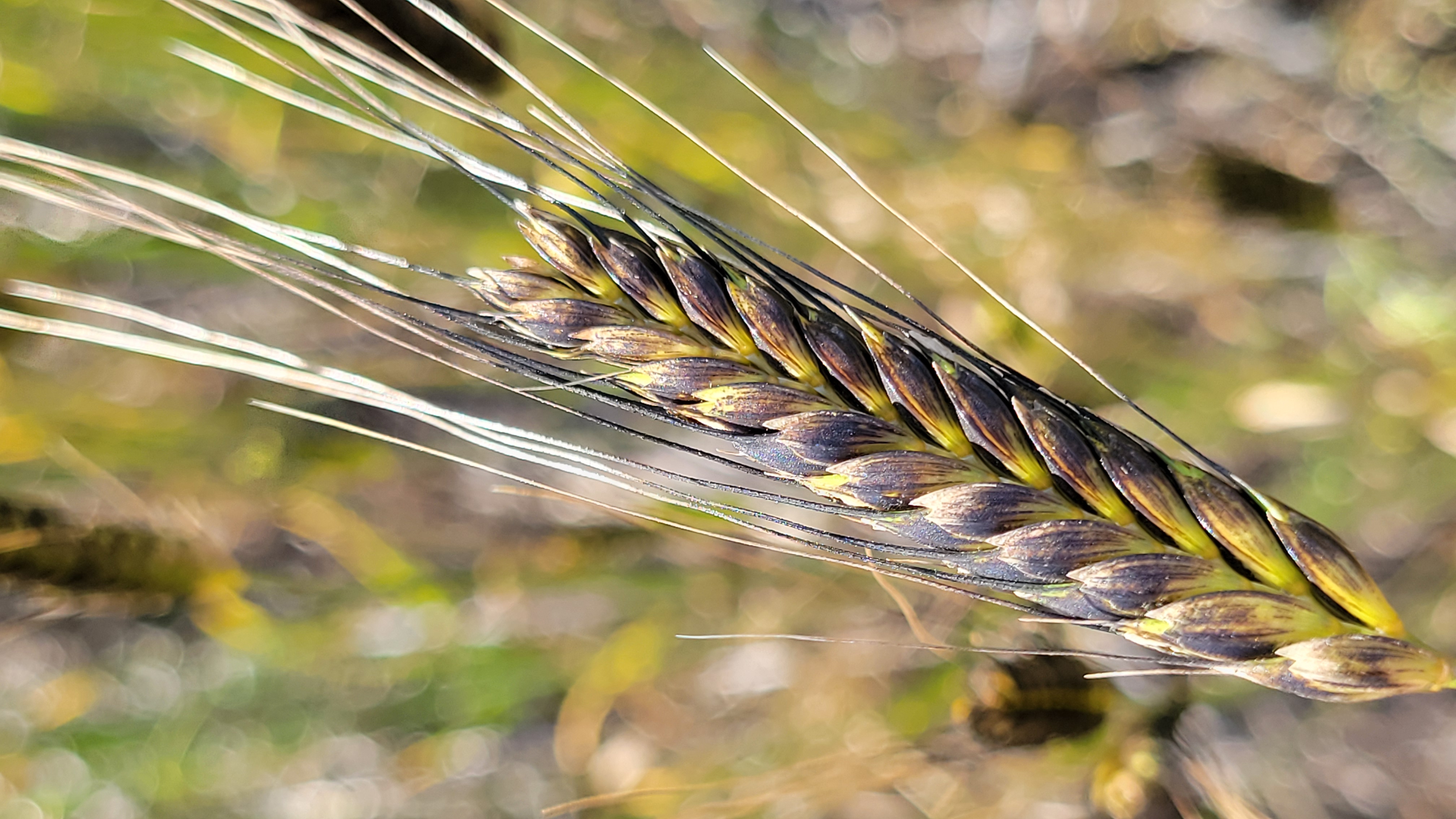
Einkorn is Triticum monococcum — the oldest cultivated wheat on earth. Farmers first grew it about 10,000 years ago in southeastern Anatolia, which is now Turkey.8 Every wheat you've eaten since descended from it in some way. But einkorn itself was never crossed with anything else.
Here's the chromosome count: einkorn has 14. Modern bread wheat has 42.2 Those extra chromosomes didn't come from wheat breeding. They came from two separate hybridization events with a wild grass called goat grass (Aegilops tauschii). That happened roughly 9,000 years ago, and it added an entirely new genome to wheat — called the D-genome.
Einkorn missed both of those merges. It has no D-genome. It is the only major wheat that doesn't. And that one fact explains almost everything else on this page.
"Einkorn has 14 chromosomes. Modern bread wheat has 42. The extra ones came from goat grass. Twice. Einkorn missed both of those merges."
The gluten thing — the part most people care about
If you've ever looked into why wheat bothers some people, you've probably come across the word gliadin. Gliadins are a family of proteins inside wheat gluten. One specific fragment — called the 33-mer peptide — is the main trigger for celiac disease. It's the most immunologically potent peptide in wheat, it resists normal digestion, and it kicks off the immune response that damages the gut in celiac patients.
The genes that make the 33-mer sit on the D-genome.1,4
Einkorn has no D-genome. So einkorn cannot produce the 33-mer peptide. This has been confirmed by LC-MS/MS mass spectrometry — a lab technique that identifies specific proteins with high precision. Multiple independent studies have run the test. The 33-mer shows up in common wheat and in spelt. It does not show up in einkorn, durum, or emmer.1,4
Important honesty here: einkorn is not safe for celiac disease. It still contains other immunogenic peptides. One study cataloguing einkorn line ID1331 found 4 toxic peptides and 13 immunogenic peptides across its gliadin proteins.10 If you have celiac disease, do not eat einkorn.
But for people with non-celiac gluten sensitivity (NCGS) — the much larger group who feel unwell from wheat but test negative for celiac — the picture is different. One in vivo challenge study in celiac patients showed that einkorn produced a significantly reduced immune response compared to hexaploid (modern) wheat.9 That's a clinical result, not a testimonial.
The hidden inflammation factor: ATIs
Gluten gets all the press. But researchers have been building a case for a second class of wheat proteins called amylase-trypsin inhibitors, or ATIs. These are smaller proteins that activate the innate immune system — the fast, non-specific part of your immune response. Studies now link them directly to non-celiac wheat sensitivity and intestinal inflammation.
Einkorn has far fewer of them than modern wheat.
A 2023 study comparing the full protein profiles of four wheat species found that total allergenic proteins in einkorn are 5.4 times lower than in common wheat.3 ATIs specifically? Einkorn has 7.2 times fewer ATIs than common wheat, 7.3 times fewer than spelt, 5.2 times fewer than durum, and 4.7 times fewer than emmer.
The einkorn ATIs that do exist (CMX1 and CMX3) are also more digestible than the modern wheat versions — broken down faster in the gut, triggering less immune activation.6
Plain English: it's not just gluten that bothers people. There's a second class of proteins that research now ties to wheat sensitivity, and einkorn has about seven times less of it than the flour at your grocery store.
"ATIs are a second class of wheat protein. Einkorn has 7 times less of them than regular bread wheat."
Einkorn vs modern bread wheat
| Trait | Einkorn | Modern Bread Wheat |
|---|---|---|
| Chromosomes | 14 (diploid, AᵚAᵚ) | 42 (hexaploid, AABBDD) |
| 33-mer celiac peptide | Absent | Present |
| ATIs (inflammatory proteins) | 7.2x lower | Baseline |
| Total allergenic proteins | 5.4x lower | Baseline |
| Lutein | 3–10x higher | Baseline |
| Gas retention in baking | 99.1–99.3% | 88.7% |
| Loaf volume | 732–740 cm³ | 671 cm³ |
| Crumb hardness | 2.44–3.26 N | 4.35 N |
| Yield per acre | ~70% lower | Baseline |
| Disease resistance | High (84% leaf rust resistant) | Relies on fungicides |
Sources: Juhász et al. 2023 (ATIs, allergenic proteins), Taddei et al. 2023 (baking data), Shewry 2009 (chromosomes), Farooq et al. 2014 (disease resistance).
Nutrition you can actually measure
Einkorn consistently tops the charts when researchers compare it to other wheats. A detailed LC-ESI-MS/MS analysis found einkorn ranked highest among four wheat species for: Vitamin B1 (thiamine), B2 (riboflavin), B5 (pantothenic acid), B9 (folate), and Vitamin E (alpha-tocopherol).5
Folate is worth pausing on. Modern refined flour has to be fortified with synthetic folic acid by law in many countries, specifically to prevent neural tube defects — because the milling process strips out the natural folate. Einkorn delivers it without fortification, still in its natural form.
Then there's lutein. That's the carotenoid that gives einkorn its yellow color. Einkorn contains 3 to 8 times more lutein than modern soft wheat, and roughly twice what you find in durum.6 One study measuring yellow pigment put einkorn at approximately 10 times higher than modern bread wheat. Lutein isn't just a color — it's an antioxidant linked to eye health and reduced inflammation.
Einkorn is also higher in iron, zinc, and steryl ferulates (plant compounds with antioxidant properties). These aren't trace differences. They're consistent findings across multiple independent labs.
We had our own flour tested too. Third-party labs, actual numbers from our farm. You can see the results at bettergrain.ca/nutrition.html.
How it bakes
Here's the paradox. Einkorn's gluten is structurally "weaker" than modern wheat — lower elasticity, more extensibility. If you put it in an industrial mixer and run it through a long fermentation cycle, the dough falls apart. That's why big bakeries won't touch it.
But in artisanal baking, it outperforms modern wheat on almost every metric that matters to a home baker.
A study testing elite einkorn varieties found gas retention of 99.1 to 99.3% — compared to 88.7% for the standard bread wheat control.6 That's not a small gap. Loaf volume came in at 732 to 740 cm³ for einkorn vs 671 cm³ for the control. Bigger loaves. Crumb hardness at production was 2.44 to 3.26 N for einkorn compared to 4.35 N for bread wheat — softer bread right out of the oven.
It also stays fresh longer. A 52-hour shelf-life trial showed einkorn undergoes slower starch retrogradation — which is just a way of saying it stales more slowly than modern bread wheat.6
Einkorn absorbs less water too: about 52.5% vs 58.8% for bread wheat. That's why you reduce hydration when swapping it in. It also has more soluble pentosans, which improve how the dough holds moisture.
For practical baking: cakes and quick breads usually swap 1:1 with no changes. Yeast breads, reduce your water a bit. Sourdough, start around 75% hydration. The dough is stickier than you're used to. That's not a mistake — that's normal for einkorn.
Why it's rare
Einkorn yields about 70% less grain per acre than modern winter wheat under the same growing conditions. The plant is tall — too tall for modern harvesting equipment in some cases — and it tends to lodge (fall over before harvest). The grain also comes in a hull that has to be removed before milling, which modern wheat doesn't require.
Those are real costs. They don't disappear through better marketing or economies of scale. The price of einkorn flour reflects biology, not branding.
On the other side: einkorn is genuinely tough. It tolerates cold stress better than bread wheat during germination and handles drought stress at the seedling stage.7 It grows in marginal soils — sandy, low-nitrogen, high-altitude ground where modern wheat fails. And it has strong genetic resistance to fungal disease: 84% of Triticum monococcum accessions tested showed resistance to leaf rust, with resistance working across multiple strains simultaneously.
That last point is why einkorn fields don't need fungicide sprays. The grain's genetics protect it. That's not a farming philosophy choice — it's just how the plant works.
Where our einkorn comes from
Our family farms in Alberta. No pesticides, no herbicides, no fungicides. As you now know, the grain wouldn't tolerate most of them anyway. We grow the einkorn, de-hull it, mill it, and ship it directly to you. Here's why we started.
The flour in your bread is coming from the field that grew it. Not a commodity supply chain. Not a warehouse that buys from a warehouse. One farm, one grain, direct to your door.
How to bake with einkorn flour
The rules are simple once you know them.
-
1. Start with lower hydration. Einkorn absorbs about 6% less water than standard bread flour. For sourdough, start at 75% hydration. For sandwich loaves, reduce water by 10 to 15% from your regular recipe. The dough is stickier than you're used to — that's not a mistake.
-
2. Swap 1:1 for cakes and quick breads. Muffins, pancakes, quick breads: replace all-purpose flour with einkorn 1:1. No other changes needed. The flavor is nuttier and the crumb slightly more tender.
-
3. Knead less, fold more. Einkorn gluten is more extensible and less elastic. Overworking weakens the dough. Use stretch-and-fold instead of aggressive kneading, and rest the dough between folds.
-
4. Trust the stickiness. Do not add more flour to compensate for stickiness. The extra moisture comes from higher pentosan content, which is part of why einkorn bread stays fresh longer than modern wheat bread. Let it rest and it will come together.
Ready to try it yourself? We ship direct from the farm.
Shop Einkorn →Alberta-grown. Shipped to your door.
Common questions
Is einkorn flour gluten-free?
No. Einkorn has gluten and is not safe for celiac disease. What makes it different from modern wheat isn't the presence of gluten — it's the type. Einkorn lacks the D-genome, which means it cannot produce the 33-mer peptide — the most potent celiac trigger in modern wheat. It also has 7 times fewer ATI proteins, the second class of inflammatory wheat proteins. But it still contains other immunogenic proteins, so celiacs should avoid it.
Is einkorn safe for celiac disease?
No. This one deserves a straight answer. Research has confirmed 4 toxic peptides and 13 immunogenic peptides in einkorn. The 33-mer is absent, and the overall immune response may be lower, but einkorn is not safe for people with diagnosed celiac disease. Full stop.
How is einkorn different from spelt?
Spelt and einkorn are completely different wheats. Spelt has 42 chromosomes — same as modern bread wheat — and it has the D-genome that einkorn lacks. That matters because LC-MS/MS testing has confirmed the 33-mer celiac-trigger peptide is present in spelt but absent in einkorn. Different genetics, different behavior in the body, different flavor in the pan.
Why is einkorn flour yellow?
Lutein. It's a carotenoid antioxidant that gives einkorn its distinctive color. Einkorn has 3 to 10 times more lutein than modern bread wheat. Modern wheat lost most of its carotenoids through decades of selection for white flour. Einkorn kept them because nobody changed it. The yellow color is the visible proof of the nutrient difference.
Why is einkorn more expensive?
Einkorn yields about 70% less grain per acre than modern winter wheat. The plant is taller, falls over more easily, and requires a de-hulling step that modern wheat doesn't. Those are hard biological costs. The price reflects that, not a premium markup.
Can I substitute einkorn 1:1 for all-purpose flour?
Usually yes for cakes and quick breads. For yeast breads, reduce your water slightly — einkorn absorbs about 6% less water than standard bread flour. For sourdough, start around 75% hydration. The dough will feel stickier than you're used to. Don't add more flour to compensate — just trust it and let it rest.