
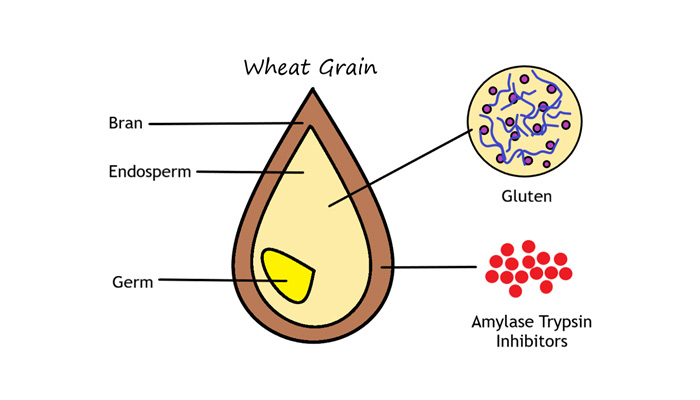
- ATIs (amylase-trypsin inhibitors) are proteins in wheat that survive digestion and trigger gut inflammation — separate from gluten.
- Modern bread wheat contains roughly 1.2–6 mg of ATIs per gram of flour.
- Einkorn has been confirmed by LC-MS/MS proteomics to have a very low total ATI content vs all other tested wheat species.
- Spelt and emmer are not the same — they have more ATIs than modern wheat.
- ATIs activate the TLR4 innate immune pathway, the leading suspect behind non-celiac wheat sensitivity (NCGS).
- Sourdough fermentation significantly degrades ATI bioactivity in high-ATI flours.
- Einkorn is not gluten-free and is not safe for celiac disease.
You've probably heard this before: "I gave up gluten and feel so much better." But here's the thing — for a lot of people, gluten may not be the actual problem.
Researchers have identified a different class of wheat proteins called amylase-trypsin inhibitors, or ATIs, that trigger gut inflammation in a completely different way than gluten does. And einkorn — the ancient diploid wheat — has far fewer of them than any other tested wheat species.
This isn't just interesting. For the millions of people who react to modern wheat but don't have celiac disease, it's one of the most important distinctions in grain science today.
"It might not be the gluten. It might be the ATIs."
What Are ATIs?
Amylase-trypsin inhibitors are a family of small proteins that wheat produces to defend itself against insects and other pests. Their job is to block digestive enzymes in bugs — which is exactly what they do. They inhibit amylase (which breaks down starch) and trypsin (which breaks down protein).1
The problem for humans: ATIs are remarkably resistant to digestion. They survive stomach acid and intestinal enzymes, reach the gut lining intact, and interact with immune cells there.2,3
Once they arrive, they bind to a receptor on the surface of immune cells called TLR4 (Toll-like receptor 4). This triggers the innate immune system — the body's first-line, non-specific defense — releasing pro-inflammatory signals and causing intestinal inflammation.4,5
This pathway is completely separate from celiac disease. Celiac is an adaptive immune response to gluten peptides. ATI inflammation is an innate immune response — faster, blunter, and not gluten-dependent. You can react to ATIs even if you don't react to gluten.
How Much Is in Modern Wheat?
ATIs make up roughly 2–4% of total wheat protein.6,7 Given that flour typically contains 10–15% protein, that works out to an absolute content of approximately 2–6 mg per gram of flour.8 Independent measurements using reversed-phase HPLC confirmed values in the range of 1.2–4.2 mg/g.9
Every slice of bread, every bowl of pasta, every cracker from modern wheat carries a real dose of these proteins. For most people, that's fine. But for a meaningful subset — the people who feel foggy, bloated, or unwell after eating wheat without any celiac diagnosis — ATIs are now a leading scientific explanation.
Einkorn's ATI Advantage
Here's where einkorn stands apart — not just from modern wheat, but from every other wheat species tested.
Multiple studies using targeted liquid chromatography-tandem mass spectrometry (LC-MS/MS) — the gold standard in protein quantification — have explicitly concluded that einkorn has a "very low total ATI content" compared to common wheat, spelt, durum, and emmer.10,11
The researchers confirmed this finding is significant precisely because it is measurable and specific. It's not a vague claim about "ancient grains being better." It is a precise proteomic difference — and it has direct implications for NCGS patients.11
| Wheat Species | Total ATI Content | Method |
|---|---|---|
| Modern Bread Wheat (T. aestivum) | ~2–6 mg/g flour | Predicted from % protein |
| Modern Bread Wheat (T. aestivum) | 1.2–4.2 mg/g flour | Reversed-phase HPLC |
| Emmer (T. dicoccum) | Higher than modern wheat | Comparative LC-MS/MS |
| Spelt (T. spelta) | Higher than modern wheat | Comparative LC-MS/MS |
| Einkorn (T. monococcum) | Very low — lowest tested | Comparative LC-MS/MS |
Sources: Geisslitz et al., 2020; Geisslitz & Ludwig, 2019; RP-HPLC data, 2023.
The Spelt and Emmer Surprise
People often assume that "ancient" automatically means "safer." This data shows that's wrong.
Spelt and emmer — both marketed as ancient grain alternatives — were found to contain even more ATIs than modern bread wheat.10 If someone is switching to spelt because they think it's gentler on their gut, the ATI research suggests they may be making the opposite choice.
The specific nature of einkorn's low ATI profile is the result of its unique genome — not just its age.
"Spelt and emmer have more ATIs than modern bread wheat. The 'ancient grain' label isn't enough."
Why Einkorn Is Different: The Genomic Reason
The difference comes down to chromosomes. Einkorn (Triticum monococcum) is a diploid — it has a single set of 14 chromosomes, the original wheat genome.12,13
Modern bread wheat (Triticum aestivum) is a hexaploid allopolyploid — it has three complete sets of chromosomes (AABBDD genomes, 42 total), the result of multiple natural hybridization events followed by centuries of agricultural selection.14,15
More genomes means more gene copies. More gene copies means more capacity to produce defense proteins — including ATIs. Modern wheat's higher ATI load is essentially an evolutionary arms race that agriculture selected for because more ATIs meant better pest resistance in the field.
Einkorn never went through that selection pressure. Its simpler diploid genome encodes a simpler, smaller defensive protein arsenal — which turns out to be much friendlier to the human gut.16
Modern Bread Wheat
- • 42 chromosomes (hexaploid)
- • 3 sub-genomes (AABBDD)
- • High ATI content (1.2–6 mg/g)
- • Complex defensive proteome
Einkorn
- • 14 chromosomes (diploid)
- • 1 sub-genome (AA)
- • Very low ATI content
- • Simpler defensive proteome
ATIs and Non-Celiac Wheat Sensitivity
Non-celiac gluten sensitivity (NCGS, also called NCWS) is a condition affecting a substantial portion of the population — people who feel unwell after eating wheat (bloating, fatigue, headaches, brain fog, joint pain) but test negative for celiac disease and wheat allergy.17,18
For years, the mechanism was unclear. Researchers are now building a strong case that ATIs are a primary trigger — not gluten.
The evidence:
- ATIs activate the TLR4-MD2-CD14 receptor complex on myeloid immune cells at the nanomolar level, releasing pro-inflammatory cytokines including IL-6 and IL-8.4,5
- Patients with primary sclerosing cholangitis and associated colitis showed significant reductions in mucosal pro-inflammatory markers on a diet restricting both gluten and ATIs.19
- In animal models, wild-type mice fed ATIs developed intestinal dysfunction. Mice susceptible to gluten-induced inflammation showed worse symptoms when also exposed to ATIs.20
- ATIs survive proteolytic digestion, reaching the gut epithelium in bioactive form capable of initiating inflammatory cascades.2,21
The lower ATI load in einkorn directly reduces exposure to this inflammatory trigger. That's the most likely scientific explanation for why many people with wheat sensitivity report tolerating einkorn better than modern wheat.11
What About the Immunogenicity of Einkorn's ATIs Specifically?
Here's where the science stays honest. The research confirms einkorn has fewer ATIs. What's less clear is whether einkorn's ATI proteins are intrinsically less inflammatory than modern wheat's ATI proteins, independently of quantity.
One study suggests einkorn ATIs have a "reduced potential to elicit innate immune response" compared to T. aestivum.22 But detailed head-to-head structural comparisons — like X-ray crystallography or molecular modeling of specific isoforms — haven't been published yet.
The bottom line: einkorn's primary advantage is quantitative. You get far less of a known inflammatory protein. That's enough to matter for most sensitive individuals. Whether the proteins themselves are structurally different is still an open research question.
What You Can Do Today
Choose einkorn
The most direct path to lower ATI exposure is choosing a grain that simply has less of them. Einkorn flour and berries, eaten in any preparation, start from a significantly lower baseline.
We grow einkorn on our family farm in Alberta using no pesticides, herbicides, or insecticides. If you're curious about trying it, we're offering early access to our harvest — berries, flour, and pasta.
Use sourdough fermentation
If you're baking with modern wheat, sourdough fermentation is your best processing tool. The lactic acid bacteria in sourdough cultures actively degrade ATI protein structure throughout the bread-making process — breaking down tetramers and other forms, significantly reducing pro-inflammatory potential.23,24,25
Sourdough einkorn bread combines both advantages: a naturally low starting ATI level, further reduced by fermentation. It's the best of both approaches.
Germination and soaking
These traditional grain preparation methods have been shown to reduce trypsin inhibitor activity in cereal grains.26 Soaking and sprouting your einkorn berries before cooking is a simple additional step with potential digestive benefits.
"Einkorn is not a miracle cure. It's a better starting point."
Important: Einkorn Is Not Gluten-Free
This deserves its own section because it's the most important safety note in this article.
Einkorn contains gluten. It is not safe for people with celiac disease. The ATI difference does not change einkorn's gluten content. If you have a confirmed celiac diagnosis, einkorn is not an option for you.
The benefits described here apply to people with non-celiac wheat sensitivity (NCGS) — a separate condition without the autoimmune component of celiac. If you're unsure which applies to you, please see a gastroenterologist. A proper diagnosis matters.
For people with NCGS who are curious about einkorn, the research supports trying it. But it's not a treatment, and individual results vary.
The Future: CRISPR and Low-ATI Wheat
For completeness: researchers are actively working on using genome editing tools like CRISPR-Cas9 to silence the specific genes responsible for producing the most immunoreactive ATI isoforms (CM3 and CM16) in modern wheat.27,28 The goal is a high-yielding modern wheat variety with an ATI profile closer to einkorn's.
That's a long-term play. It'll be years before anything reaches consumers at scale. In the meantime, einkorn offers what biotechnology is still working toward — naturally, by virtue of its ancient genome.
We grow einkorn in Alberta using regenerative practices — no pesticides, no sprays, no shortcuts. Get early access to our harvest.
Get Early Access →No spam. Just grain news.